
Blog
How Pakistan’s Petroleum Levy Impacts Every Car Driver & What You Can Do to Protect Your Pocket – Petroleum Levy is a Bhatta Tax

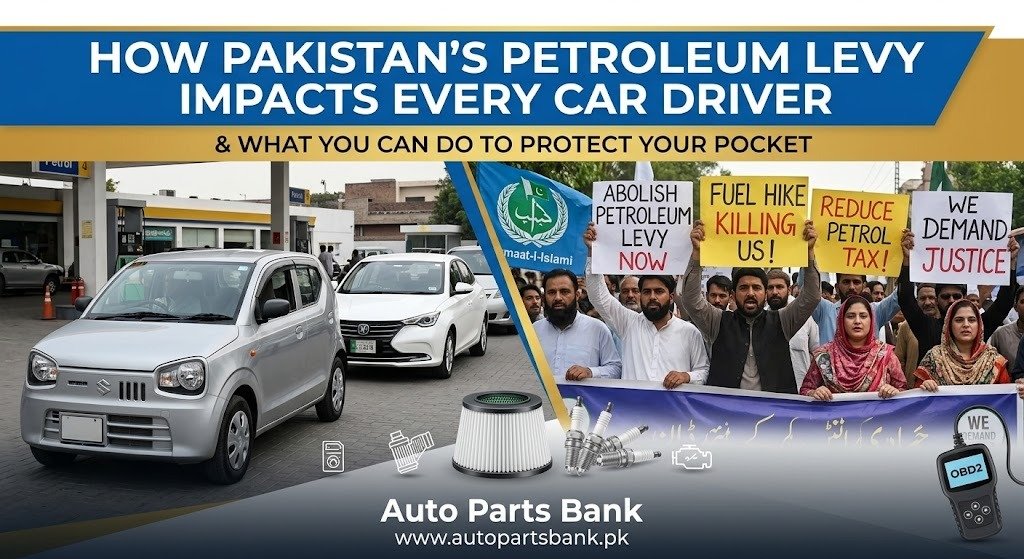
When you pull up to a petrol station in Lahore, Karachi, or Islamabad, one question dominates the mind of every Pakistani driver: “Kitna deti hai?”
Whether you drive a Suzuki Alto to work, rely on a Changan Alsvin for family commutes, or operate a bike-hailing or delivery service, fuel costs directly dictate your daily survival.
Petroleum Levy Pakistan Fuel Price
Recently, the national conversation around fuel prices reached a boiling point. Jamaat-i-Islami chief Hafiz Naeem ur Rehman filed a constitutional petition demanding the government abolish the Petroleum Levy (PL), sparking intense debate across the country.
As a nationwide provider of auto parts and accessories at Auto Parts Bank, we see firsthand how skyrocketing fuel costs impact everyday vehicle runners. Here is a breakdown of what the Petroleum Levy actually is, how it affects your car’s operating costs, and practical steps you can take to protect your vehicle’s fuel efficiency.
1. What is the Petroleum Levy & Why Is It Hitting Drivers So Hard? Petroleum Levy Pakistan Fuel Price
Historically, the Petroleum Levy was introduced as a targeted charge meant to fund oil and gas infrastructure, modernize refineries, and maintain strategic energy reserves.
However, it has transformed into a major indirect tax mechanism:
- Massive Revenue Collection: Official figures indicate Pakistan collected over Rs 1.2 trillion in Petroleum Levy during just the first nine months of the fiscal year, with full-year targets approaching Rs 1.47 trillion.
- Direct Burden on Commuters: Instead of targeting untaxed luxury sectors, a significant portion of fuel prices at the pump comes from domestic levies and taxation rather than global crude oil rates alone.
- Impact on Small Engine & Economy Cars: Millions of Pakistanis purchased economy vehicles (660cc to 1.3L) specifically to save fuel. However, when heavy levies drive petrol prices up, even the most fuel-efficient cars become expensive to run.
2. The Ripple Effect on Car Runners & Daily Drivers
Fuel price increases don’t just affect the petrol pump—they increase the total cost of car ownership across Pakistan:
- Squeezed Margins for Commercial Runners: For delivery drivers, taxi operators, and ride-hailing riders operating on razor-thin profit margins, every rupee increase in the Petroleum Levy directly cuts into daily household income.
- Increased Wear and Tear: When fuel prices skyrocket, many vehicle owners delay critical vehicle maintenance to save money. Unfortunately, skipping routine engine checks leads to worse fuel consumption down the road.
- Rising Transportation Costs: Higher fuel levies push up supply chain logistics, making auto spare parts, tires, and general consumer goods more expensive to transport across provinces.
3. The Legal & Economic Debate: A Call for Relief
The constitutional petition filed against the continuous increase in the Petroleum Levy highlights critical concerns:
- Lack of Parliamentary Oversight: Critics argue that recent legislative changes gave executive authorities broad discretion to raise levies without direct parliamentary scrutiny for every hike.
- Regressive Taxation: Indirect taxes like the PL affect a low-income commuter and a wealthy individual at the exact same rate per liter, placing a disproportionate burden on lower and middle-class citizens.
- Demands for Consumer Relief: Public representatives are urging the government to pass on global price dips—such as regional oil price cuts—directly to consumers rather than absorbing them into the national treasury.
4. Practical Maintenance Steps to Maximize Every Liter
While policy debates continue in courtrooms and parliament, vehicle owners must take active steps to maintain their car’s fuel efficiency. Neglecting small replacement parts can cause your car’s mileage to drop by 20% to 40%.
Here is how you can stretch every liter of petrol:
A. Replace Dirty Engine Air Filters
A clogged air filter starves your engine of oxygen, forcing the ECU to inject extra petrol to keep moving. Replacing a dirty air filter (a low-cost maintenance step) instantly restores proper airflow and fuel economy.
B. Inspect Spark Plugs Regularly
Worn or carbon-coated spark plugs cause incomplete combustion, meaning unburnt fuel escapes through your exhaust. Replacing spark plugs at recommended intervals ensures clean ignition and optimal km/L.
C. Check Oxygen (O2) Sensors
A failing O2 sensor sends incorrect fuel-mixture data to your car’s computer, leading to excessive fuel consumption without obvious driving symptoms.
D. Maintain Correct Tire Pressure
Under-inflated tires increase rolling resistance, forcing your engine to work harder and burn significantly more fuel during daily city driving.
Drive Smarter with Auto Parts Bank
At Auto Parts Bank, we believe maintaining your vehicle should be affordable and straightforward. Whether you need genuine engine air filters, high-performance spark plugs, sensors, or synthetic motor oils for Suzuki, Toyota, Honda, Changan, or MG vehicles, we deliver quality auto parts straight to your door anywhere in Pakistan.
Keep your engine running efficiently and maximize your mileage today.
#PetrolPrice #PakistanEconomy #Inflation #CarMaintenance #AutoPartsBank #FuelEfficiency #PetroleumLevy