
Blog
Draft Auto Policy 2026–31: Potential Car Price Drops, PAAPAM’s Concerns, and the Future of Pakistan’s Auto Sector

The Government of Pakistan has finalized the draft of the new Automotive and Auto Parts Policy 2026–31. Approved by Prime Minister Shehbaz Sharif, the proposed framework is now heading to the federal cabinet for formal discussion and approval before implementation.
While prospective car buyers are looking forward to significant price reductions on popular models like the Toyota Yaris, Suzuki Cultus, and Suzuki Alto due to proposed tax cuts, domestic auto parts manufacturers—led by PAAPAM—have raised serious concerns.
At Auto Parts Bank, we take a deep dive into what the Draft Auto Policy 2026–31 proposes, how car prices could change, why local parts makers are raising red flags, and what this means for car owners and the local automotive ecosystem.
1. Projected Car Price Reductions: What Could Change for Buyers?
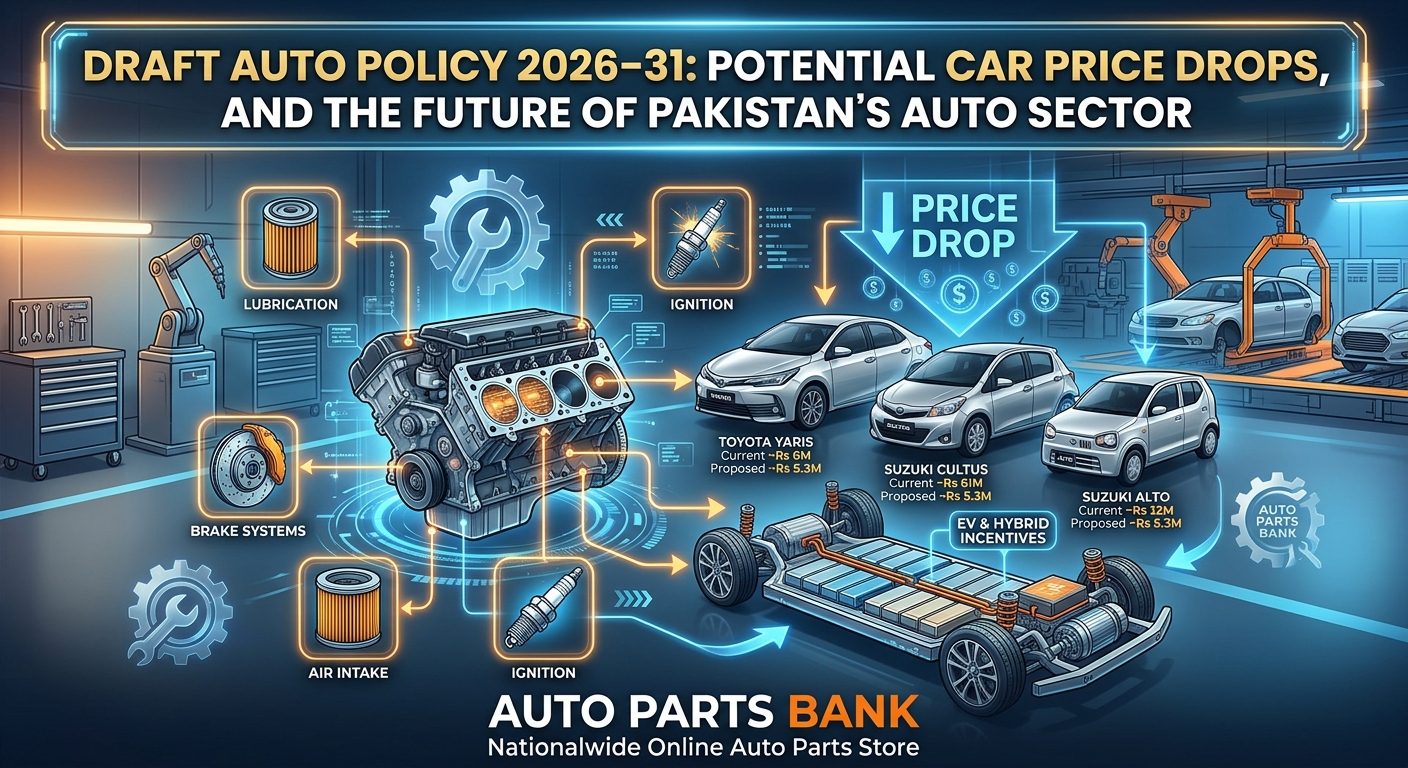
The proposed draft suggests a series of phased tariff reductions, lower import duties on vehicle components, and revised tax structures. If these changes are passed on to consumers by automobile assemblers, several popular passenger cars in Pakistan could see notable price drops:
| Car Model | Current / Estimated Price | Projected New Price | Estimated Savings |
| Toyota Yaris | ~Rs. 6.00 Million | ~Rs. 5.30 Million | ~Rs. 700,000 |
| Suzuki Cultus | ~Rs. 4.30 Million | ~Rs. 3.80 Million | ~Rs. 500,000 |
| Suzuki Alto | ~Rs. 3.20 Million | ~Rs. 2.845 Million | ~Rs. 355,000 |
⚠️ Disclaimer: These figures are preliminary estimates based on publicly reported draft calculations. Final market prices will depend on cabinet approval, corporate pricing strategies, and final tax regulations.
2. Invalidation of Tariff Protection: PAAPAM Urges PM to Review
While lower import duties sound promising for buyers looking for cheaper vehicles, the local manufacturing sector has voiced strong objections.
In an official letter dated October 23, Abdul Rehman Aizaz, Chairman of the Pakistan Association of Automotive Parts and Accessories Manufacturers (PAAPAM), urged PM Shehbaz Sharif to review the proposed tariff cuts and new-energy vehicle concessions.
Key Facts Highlighted by PAAPAM:
- Industry Scale: The domestic auto parts industry comprises over 1,200 local manufacturing companies.
- Employment: Supports approximately 1.5 million direct and indirect jobs across Pakistan.
- Economic Contribution: Generates $1.8 billion annually in import substitution and supplies Rs. 700 billion worth of localized components to vehicle assemblers every year.
PAAPAM warns that opening the market to cheaper imported completely built-up (CBU) vehicles and imported components could severely weaken domestic parts manufacturing, jeopardize decades of investment, and lead to widespread job losses.
3. Pushing for New-Energy Vehicles (NEVs) & $6 Billion Export Target
To modernize the sector and align with global environmental standards, the Draft Auto Policy 2026–31 offers targeted sales tax concessions for electric and hybrid powertrains:
- Battery-Electric Vehicles (BEVs): Proposed 1% Sales Tax.
- Range-Extended Electric Vehicles (REEVs): Proposed 6% Sales Tax.
- Plug-in Hybrid Electric Vehicles (PHEVs): Proposed 9% Sales Tax.
In addition, the policy sets an aggressive target of achieving $6 billion in cumulative exports of vehicles and automotive components by 2030–31. To enforce this, the government plans to introduce financial incentives for manufacturers meeting export quotas, paired with penalties for those failing to comply.
4. Japanese Legacy vs. Chinese Innovation: A Shifting Landscape
Pakistan’s automotive market is undergoing its biggest transformation in decades. Historically dominated by traditional Japanese giants—Toyota, Honda, and Suzuki—the market has seen a surge of Chinese entry with conventional petrol, hybrid, and fully electric models.
This diversification has created divisions within the industry:
- Importers & New Entrants: Favor reduced trade barriers and lower tariffs to rapidly bring diverse models into the country.
- Local Parts Manufacturers (PAAPAM): Fear that easier component imports will bypass local supply chains and destroy domestic production capacity.
- Traditional Assemblers: Argue that while competition is welcome, rapid policy shifts could disrupt localized supply networks built over three decades.
As one senior industry representative noted, long-term stability, higher domestic value addition, and true technology transfer are required so that local manufacturers can remain competitive without relying indefinitely on protectionism.
What This Means for Car Owners & Auto Parts Bank
Whether the government leans toward protecting local manufacturing or encouraging competition through lower import duties, one thing remains clear: vehicle maintenance and parts quality will remain a top priority for Pakistani drivers.
At Auto Parts Bank, we are committed to supporting local car owners and workshops by providing certified, high-grade OEM and aftermarket replacement parts—for Japanese, Chinese, and local vehicle models alike.
Stay tuned to our blog for further updates on the cabinet approval process for Auto Policy 2026–31 and official car price announcements!
👉 Explore Genuine Car Parts & Accessories at Auto Parts Bank